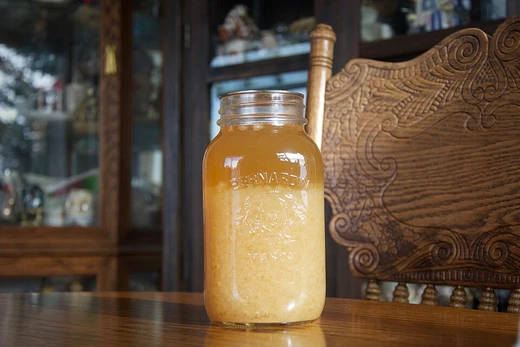
Vinegar
Sour liquid used in cooking, cleaning, and medicine for millennia.
Vinegar is an odorous aqueous solution of diluted acetic acid and trace compounds, typically containing from 4% to 18% acetic acid by volume. It is produced by a double fermentation process—converting simple sugars to ethanol using yeast, then ethanol to acetic acid using acetic acid bacteria—and has been used since ancient times for culinary, medicinal, and industrial purposes.
- chemical_formula
- CH3COOH (acetic acid)
- typical_acidity
- 4% to 18% acetic acid by volume
- earliest_evidence
- circa 3000 BCE by ancient Babylonians
- key_fermentation_agent
- acetic acid bacteria
- major_production_methods
- slow fermentation (months to a year) and fast fermentation (1–3 days)
- common_uses
- culinary ingredient, salad dressing, pickling agent, household cleaner
Lore & Background
The word 'vinegar' arrived in Middle English from Old French 'vyn egre' (sour wine), which derives from Latin 'vīnum' (wine) and 'ācre' (sour). The first documented evidence of vinegar making and use was by the ancient Babylonians around 3000 BCE, who made it from fruits, dates, figs, and beer for culinary and medicinal purposes. Traces have also been found in Egyptian urns. In East Asia, the Chinese began professionalizing vinegar production in the Zhou dynasty, with the book Zhou Li mentioning a specialized 'vinegar maker' in noble households. Many Chinese kinds of vinegar were recorded in the agricultural manual Qimin Yaoshu. The Greeks and Romans frequently used vinegar made from wine; the Spartans used it in their traditional blood soup melas zomos to prevent coagulation. The Roman Columella described vinegar-making in his work Res Rustica. In the late Middle Ages, the French city of Orléans became famous for its vinegar through the Orléans process, while malt vinegar (first known as alegar) developed in England and balsamic vinegar evolved in the Duchy of Modena. In the 19th century, Karl Sebastian Schüzenbach invented the packed generator in the Kingdom of Baden in 1823, reducing fermentation times from months to 1–2 weeks. Louis Pasteur discovered that acetic acid bacteria were the agent of fermentation. In the 20th century, submerged fermentation cut production times to 1–2 days.
Reader's Guide
Vinegar's significance lies in its long history as a versatile product used across cultures for cooking, preservation, medicine, and cleaning. Its production methods have evolved from ancient fermentation to modern industrial processes, enabling mass production of cheap vinegar worldwide. The double fermentation process—first converting sugars to ethanol, then ethanol to acetic acid—is fundamental to all vinegar types. The discovery of acetic acid bacteria by Louis Pasteur established the biological basis of vinegar fermentation. Innovations such as the packed generator and submerged fermentation dramatically reduced production time, making vinegar widely accessible. Vinegar's chemical properties, particularly its acidity, allow it to function as a preservative (as in pickling), a flavoring agent (in salad dressings and condiments like balsamic and malt vinegar), and a household cleaner. The variety of source materials—fruits, grains, palm sap, and pure alcohol—has led to numerous regional specialties, from coconut vinegar in Southeast Asia to balsamic vinegar in Italy. Vinegar remains a staple in kitchens and industries globally, valued for its acidity, flavor, and preservative qualities.
Did You Know?
- The word 'vinegar' derives from Old French 'vyn egre', meaning 'sour wine'.
- The first documented evidence of vinegar making was by the ancient Babylonians around 3000 BCE.
- Louis Pasteur discovered that acetic acid bacteria are the agent of fermentation for vinegar production.
- The packed generator, invented in 1823, reduced vinegar fermentation time from several months to 1–2 weeks.
Frequently Asked Questions
What is Vinegar?
Vinegar is a sharp, odorous liquid composed mainly of water and diluted acetic acid, with acidity typically falling between 4% and 18% by volume. It is one of the oldest fermented condiments in human culinary history.
How is Vinegar made?
Production involves a two-stage fermentation: yeast first turns simple sugars into ethanol, and acetic acid bacteria then oxidize that ethanol into acetic acid. Depending on the method chosen, the process can finish in as little as one to three days or stretch out over a full year.
How far back does Vinegar's lore go?
The earliest documented evidence points to roughly 3000 BCE, with ancient Babylonians already incorporating it into daily life. Over the millennia it has accumulated roles in cooking, medicine, and industrial applications across countless cultures.
What can Vinegar actually do?
In the kitchen it shines as a salad-dressing base, a pickling agent, and a general flavoring ingredient. Outside the kitchen it serves as a household cleaner and has a long history of medicinal use, making it one of the most versatile fermented products out there.
What is Vinegar's core chemical identity?
The defining compound is acetic acid (CH3COOH), dissolved in water alongside a small mix of trace flavor molecules. That acetic acid concentration, usually sitting in the 4-to-18% range, is what delivers the unmistakable sharp tang fans associate with it.
More in Fermented Foods 1-17
Spotted an error? Know more?
This is a living reference — every entry is fact-audited, and reader corrections feed straight into our audit queue. Suggest an edit · See this site's audit record