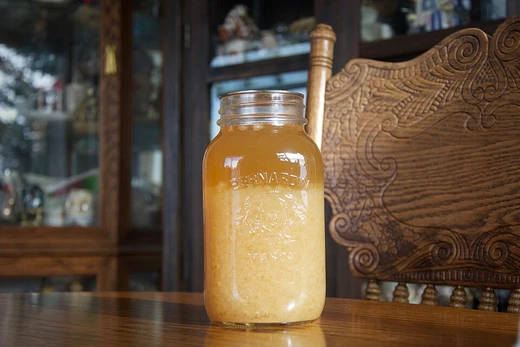
Doubanjiang
A fermented chili bean paste central to Sichuan cuisine.
Doubanjiang, also known as douban, toban-djan, broad bean chili sauce, or fermented chili bean paste, is a hot and savory Chinese bean paste made from fermented broad beans (fava beans), chili peppers, soybeans, salt, and flour. Characteristically used in Sichuan cuisine, it has been called 'the soul of Sichuan cuisine.' The best-known variety is Pixian doubanjiang, named for Pixian (now Pidu District, Chengdu city), Sichuan, which is produced with a long fermentation period under sunlight, often longer than three years.
- Type
- Fermented bean paste
- Origin
- China (Sichuan region, with Pixian as the best-known variety)
- Key Ingredients
- Broad beans, chili peppers, soybeans, salt, flour
- Known For
- Soul of Sichuan cuisine; key ingredient in mapo tofu, Sichuan hotpot, yuxiang flavoring, shuizhu
- Protected Status
- Geographical indication (GI) protected product (GB/T 20560-2006)
- Varieties
- Pixian doubanjiang, Hongyou doubanjiang, Binzhou watermelon doubanjiang
Lore & Background
Doubanjiang is a fermented bean paste that has been called 'the soul of Sichuan cuisine.' Its best-known variety, Pixian doubanjiang, is named for Pixian (now Pidu District, Chengdu city), Sichuan, where it is produced with a long fermentation period under sunlight, often longer than three years. The traditional method is summarized in a jingle: 'flip it over during daytime, expose it at night, sunbathe it in sunny days, cover it when it rains.' The distinctive flavor of Pixian doubanjiang is closely tied to the geographical location of Pixian, which has more sunshine, higher air humidity, and no water pollution, providing an environment for the microbial flora needed for fermentation.
Reader's Guide
Doubanjiang is significant as a foundational ingredient in Sichuan cuisine, used in iconic dishes such as mapo tofu, Sichuan hotpot, yuxiang shredded pork, Kung Pao chicken, and shuizhu pork. Its reputation as 'the soul of Sichuan cuisine' underscores its role in providing the characteristic savory and spicy depth to these dishes. The Pixian variety, a geographical indication protected product, is distinguished by its long fermentation process and specific ingredient sourcing, including erjingtiao chili from Pixian and vicinity, broad beans from Sichuan or Yunnan, and underground water from Pixian. The production involves a multi-stage fermentation of broad beans and chili, followed by mixing and sun-drying for at least three months. The resulting paste is graded into three classes based on color, oil coating, aroma, and aftertaste. Other varieties exist, such as Hongyou doubanjiang (a non-fermented version in red chili oil) and Binzhou watermelon doubanjiang (a non-spicy fermented paste). Outside Sichuan, doubanjiang is often not spicy. Its legacy lies in its central role in defining the flavor profile of one of China's most famous regional cuisines.
Did You Know?
- Pixian doubanjiang is produced with a fermentation period often longer than three years under sunlight.
- The jingle for Pixian doubanjiang describes the method: 'flip it over during daytime, expose it at night, sunbathe it in sunny days, cover it when it rains.'
- Pixian doubanjiang is a geographical indication protected product with quality standards last published in 2006 (GB/T 20560-2006).
- Binzhou watermelon doubanjiang is a non-spicy variety made with soybeans, watermelon, flour, and salt.
Frequently Asked Questions
What is Doubanjiang?
Doubanjiang is a pungent, umami-rich fermented bean paste that anchors Sichuan cooking. It goes by several names, including broad bean chili sauce, toban-djan, or simply douban.
What goes into making Doubanjiang?
The core blend consists of broad beans (fava beans), chili peppers, soybeans, salt, and flour, all left to ferment over time. The longer the fermentation, the deeper and more complex the flavor becomes.
What is Doubanjiang's role in the kitchen?
It is widely regarded as the foundational flavor base of Sichuan cuisine, lending heat and savor to dishes like mapo tofu, yuxiang preparations, and shuizhu. Without it, those signature Sichuan plates lose their characteristic depth.
What makes Pixian doubanjiang stand out?
Pixian (now Pidu District in Chengdu) is the most celebrated origin, where the paste undergoes an extended sun-dried fermentation that can stretch beyond three years. This slow process gives it a particularly rich, layered taste compared to quicker alternatives.
Does Doubanjiang carry any official protected status?
Yes—Pixian doubanjiang holds a geographical indication (GI) designation under Chinese standard GB/T 20560-2006, restricting the name to producers from that specific region. Other recognized varieties include Hongyou doubanjiang and Binzhou watermelon doubanjiang.
More in Fermented Foods 1-17
Spotted an error? Know more?
This is a living reference — every entry is fact-audited, and reader corrections feed straight into our audit queue. Suggest an edit · See this site's audit record