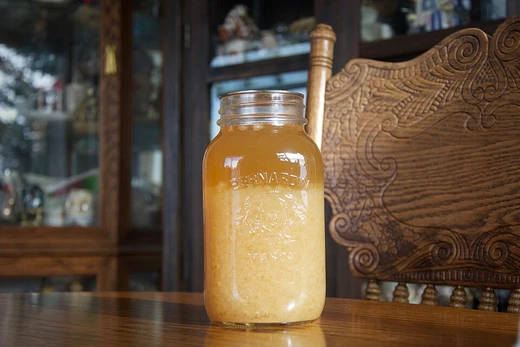
Sourdough
Ancient leavening agent using wild yeast and lactobacilli.
Sourdough is a leavening agent containing naturally occurring yeast and lactobacillus bacteria. It is used to describe bread baked with sourdough, while the sourdough itself is referred to as a starter. The fermentation process produces lactic acid, giving the bread its distinctive sour taste and improving its keeping qualities.
- field
- Food microbiology and breadmaking
- known_for
- Ancient leavening agent; basis of San Francisco sourdough; associated with Klondike gold prospectors
- key_microorganisms
- Fructilactobacillus sanfranciscensis and Kasachstania humilis
Lore & Background
Sourdough is one of the most ancient and popular forms of leavening bread. It was the standard method of breadmaking for most of human history until the Middle Ages, when it was replaced by barm. The Encyclopedia of Food Microbiology states that one of the oldest sourdough breads dates from 3700 BC and was excavated in Switzerland, but the origin likely relates to the origin of agriculture in the Fertile Crescent and Egypt several thousand years earlier. Pliny the Elder described several methods of sourdough leavening. French bakers brought sourdough techniques to Northern California during the California Gold Rush, and it remains part of San Francisco culture today. The strain of Lactobacillus in sourdough starters is named Fructilactobacillus sanfranciscensis, alongside the sourdough yeast Kasachstania humilis.
Reader's Guide
Sourdough leavening requires a pre-ferment (the starter), a live mixture of flour and water containing wild yeast and lactobacilli. The starter is maintained by periodic refreshments of flour and water. The ratio of fermented starter to fresh flour and water, called the refreshment ratio, is critical for microbial stability. A drier and cooler starter produces more acetic acid, while a wetter and warmer starter produces more lactic acid. Sourdough remained the usual form of leavening into the European Middle Ages until replaced by barm from beer-brewing, and after 1871 by purpose-cultured yeast. In English-speaking countries, sourdough is no longer the standard method, but it has undergone a revival among artisan bakers and in industrial bakeries. The term 'sourdough' also refers to Alaskan or Klondike old-timers, as prospectors carried starter pouches during the Klondike Gold Rush of 1898.
Did You Know?
- One of the oldest sourdough breads dates from 3700 BC and was excavated in Switzerland.
- The sourdough starter contains the bacterium Fructilactobacillus sanfranciscensis and the yeast Kasachstania humilis.
- Freezing does not kill a sourdough starter; excessive heat does.
- The term 'sourdough' is still applied to any Alaskan or Klondike old-timer.
Frequently Asked Questions
Who is Sourdough?
Sourdough is a living leavening culture composed of wild yeast and lactic acid bacteria that has been used to raise bread since antiquity. The active culture itself is called a "starter," while "sourdough" refers to the finished loaf produced with it.
What are Sourdough's powers/role?
Sourdough's starter ferments flour and water, releasing carbon dioxide that makes dough rise and lactic acid that gives the bread its characteristic tang. That same acid production also extends the loaf's shelf life compared with bread leavened by commercial yeast alone.
How does Sourdough's story end?
A well-maintained sourdough starter never truly ends—it can be fed, revived, and passed down through generations indefinitely. The baked bread, however, has a finite life, though the lactic acid generated during fermentation helps it stay fresh longer than conventional loaves.
Why is Sourdough important?
Sourdough predates commercial yeast by millennia, making it one of humanity's oldest food technologies. It underpins San Francisco's iconic sourdough bread and was famously carried by Klondike gold prospectors as a reliable way to make bread in remote conditions.
Who are Sourdough's key allies?
The two microorganisms most associated with classic San Francisco sourdough are Fructilactobacillus sanfranciscensis, a lactic-acid-producing bacterium, and Kasachstania humilis, a yeast species. Together they drive both the leavening action and the distinctive sour tang that define the loaf.
More in Fermented Foods 1-17
Spotted an error? Know more?
This is a living reference — every entry is fact-audited, and reader corrections feed straight into our audit queue. Suggest an edit · See this site's audit record