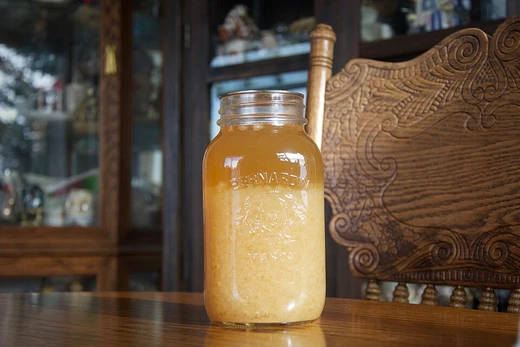
Kefir
Fermented milk drink made from symbiotic kefir grains.
Kefir is a fermented milk drink similar to thin yogurt or ayran, made from kefir grains—a specific type of mesophilic symbiotic culture. It is prepared by inoculating the milk of cows, goats, or sheep with these grains and is a common breakfast, lunch, or dinner drink in countries of West Asia and Central and Eastern Europe.
- type
- Fermented milk drink
- origin
- North Caucasus region
- known_for
- Probiotic beverage made from kefir grains
- first_attested_in_English
- 1880s
- primary_milks_used
- Cow, goat, sheep
Lore & Background
Kefir has been found in graves in the Bronze Age Xiaohe Cemetery, dating back 3,600 years. The word kefir is of North Caucasian origin, with related words in Mingrelian, Karachay-Balkar, and Ossetian. One theory suggests it comes from Old Turkic köpür '(milk) froth'. It was loaned into Russian in the 1870s and into English in the 1880s, becoming an internationalism found in many European languages.
Traditional kefir was made in goatskin bags hung near a doorway; the bags would be knocked by anyone passing through to keep the milk and kefir grains well mixed. In Karachay-Balkar, gıpı has a connection with gıpıt (wineskin), and under the name wineskin, Karachay kefir was distributed in the second half of the 19th century and at the beginning of the 20th century. Kefir spread from the former Soviet Union to the rest of Europe, Canada, Japan, and the United States by the early 21st century.
Kefir grains are initially created by auto-aggregations of Lactobacillus kefiranofaciens and yeasts, forming a biofilm matrix of heteropolysaccharides called kefiran. The grains resemble small cauliflower grains, ranging from white to creamy yellow. The symbiotic community can include acetic acid bacteria, yeasts, and various Lactobacillus species, with the microbe flora varying between batches due to factors such as temperature and grain handling.
Reader's Guide
Kefir is significant as a traditional fermented beverage with a history spanning over 3,600 years, evidenced by its presence in Bronze Age graves. It is a staple in West Asian and Central and Eastern European cuisines, consumed at any time of day alongside pastries like zelnik, burek, and banitsa, and used in cold soups. Its production relies on kefir grains, a complex symbiotic culture of bacteria and yeasts that ferment lactose into lactic acid, carbon dioxide, and small amounts of ethanol, resulting in a sour, carbonated, slightly alcoholic drink.
Kefir's legacy includes its role in traditional Circassian cuisine and its spread from the North Caucasus to global markets by the early 21st century. It is valued for its reduced lactose content—20–30% lower than milk—making it potentially suitable for people with lactose intolerance, though long-term effects have not been studied. The beverage contains probiotic bacteria such as Lactobacillus acidophilus and Bifidobacterium bifidum, as well as yeasts, and provides moderate amounts of vitamin A, vitamin B12, riboflavin, and calcium. Modern production methods include both traditional grain fermentation and freeze-dried starter cultures, with the Russian method using a two-step fermentation for larger-scale output.
Did You Know?
- Kefir has been found in graves in the Bronze Age Xiaohe Cemetery, dating back 3,600 years.
- Traditional kefir was made in goatskin bags hung near a doorway; the bags would be knocked by anyone passing through to keep the milk and kefir grains well mixed.
- During fermentation, lactose levels are decreased by 20–30% with respect to the initial lactose levels present in the milk.
- Kefir contains a small amount of ethanol; a 2016 study of kefir sold in Germany showed an ethanol level of only 0.02 g per litre.
Frequently Asked Questions
Who is Kefir?
Kefir is a fermented milk beverage whose texture and tang sit somewhere between thin yogurt and ayran. It is produced by adding kefir grains—a distinctive symbiotic culture of bacteria and yeasts—to milk and allowing them to ferment.
What are Kefir's powers or role?
Kefir is celebrated as a probiotic drink, meaning its living microbial culture delivers beneficial organisms to the person who drinks it. It serves as an everyday beverage at breakfast, lunch, or dinner across many households.
Where did Kefir originate?
Kefir traces its roots to the North Caucasus region, where it became a staple of local food culture. From there it spread throughout West Asia and Central and Eastern Europe, becoming a common table drink in those areas.
How is Kefir made?
The preparation involves inoculating milk—typically from cows, goats, or sheep—with kefir grains, which are a specific mesophilic symbiotic culture. The grains work through the milk over a set period, yielding a tangy, slightly effervescent drink.
Why is Kefir important in the Fermented Foods canon?
Kefir first appeared in English-language records in the 1880s, marking its wider recognition beyond its home region. Its lasting significance lies in being one of the most widely consumed probiotic beverages on the planet, bridging traditional pastoral food culture with modern health-minded eating.
More in Fermented Foods 1-17
Spotted an error? Know more?
This is a living reference — every entry is fact-audited, and reader corrections feed straight into our audit queue. Suggest an edit · See this site's audit record