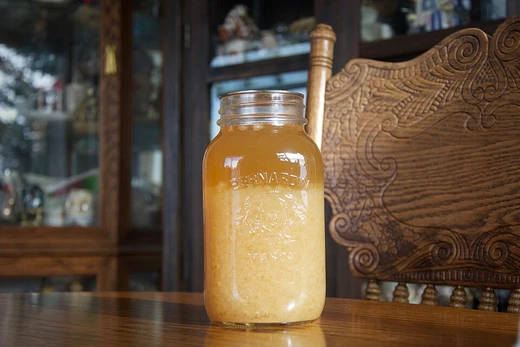
Kombucha
Fermented tea drink with uncertain origins and disputed health claims.
Kombucha is a fermented, effervescent sweetened black tea drink produced by symbiotic fermentation using a culture of bacteria and yeast (SCOBY). It is believed to have originated in China, where it was regionally traditional, and later spread to Russia, Eastern Europe, and Germany by the early 20th century. By the early 21st century, kombucha gained global popularity, particularly in the United States, and became a commercially bottled beverage with a market worth approximately US$1.7 billion as of 2019.
- origin
- Believed to have originated in the Bohai Sea region of China
- first documented in Europe
- 1852
- global market value (2019)
- US$1.7 billion
- alcohol content in commercial products
- Under 0.5% (U.S. federal threshold)
- key microbial component
- Symbiotic culture of bacteria and yeast (SCOBY)
- primary acetic acid bacterium
- Komagataeibacter xylinus (formerly Gluconacetobacter xylinus)
Lore & Background
Kombucha may have originated in the Bohai Sea region of China, but its history is not well documented. Before the 20th century, some traditional Chinese medicine practitioners used it as a remedy for lung and stomach ailments, though it was not widely known across the country. It spread to Russia before reaching Eastern and Central Europe, where it appeared in a work from 1852. Numerous myths surrounding its history have been perpetrated by Western marketing; there is no evidence it originated in Qin dynasty China or was served to Emperor Qin Shi Huang, nor that it was present in Korea or Japan before the late 20th century.
Reader's Guide
Kombucha's significance lies in its global commercial growth and its role as a probiotic beverage, though health claims remain unsupported by evidence. The drink is produced by a symbiotic culture of bacteria and yeast (SCOBY), which forms a zoogleal mat. The bacterial component almost always includes Komagataeibacter xylinus, which oxidizes yeast-produced alcohols into acetic acid. The yeast component generally includes Saccharomyces cerevisiae. Despite claims of numerous health benefits, there is little evidence to support them, and the beverage has caused rare serious adverse effects, possibly from contamination during home preparation. Commercially, kombucha faced regulatory challenges due to alcohol content; in 2010, elevated alcohol levels led retailers like Whole Foods to temporarily pull products, and suppliers reformulated to lower alcohol. By 2014, a trade organization, Kombucha Brewers International, was formed. The global market was valued at US$1.67 billion in 2019 and projected to grow to US$9.7 billion by 2030. Its etymology is uncertain, likely a misapplied loanword from Japanese, where konbucha refers to a kelp tea unrelated to the fermented drink.
Did You Know?
- The term 'kombucha' in English is believed to be a misapplied loanword from Japanese, where konbucha refers to a kelp tea, not the fermented drink.
- The SCOBY is not a fungus or mushroom but a symbiotic growth of acetic acid bacteria and osmophilic yeast species in a zoogleal mat.
- In 2010, elevated alcohol levels in bottled kombucha led retailers including Whole Foods to temporarily pull the drinks from shelves.
- Kombucha was first introduced to Japan from Russia and became a health fad after Sumako Nakamitsu's 1974 bestseller Kōcha Kinoko Health Methods.
Frequently Asked Questions
Who is Kombucha?
Kombucha is a sweetened, effervescent black tea beverage that undergoes symbiotic fermentation. It is believed to have first appeared in the Bohai Sea region of China before spreading across Russia, Eastern Europe, and Germany by the early 1900s.
What are Kombucha's powers/role?
Kombucha's defining trait is the SCOBY—a living mat of bacteria and yeast that converts sugar and tea into a tangy, fizzy drink. The primary acetic acid bacterium driving this transformation is Komagataeibacter xylinus.
How does Kombucha's story end?
Kombucha's modern chapter sees it bottled and sold worldwide, with a global market valued at roughly US$1.7 billion as of 2019. In the United States, commercial kombucha must stay below the 0.5% alcohol threshold set by federal law.
Why is Kombucha important?
Kombucha occupies a contested niche in food culture: it is celebrated as a probiotic health drink, yet its purported medicinal benefits remain scientifically disputed. Its first documented appearance in Europe dates to 1852, making it a long-standing traditional preparation despite its recent commercial boom.
What is Kombucha's true origin?
The most widely cited origin places kombucha in the Bohai Sea region of China, where it was a regional traditional preparation. Its exact birthplace and timeline remain uncertain, and no single definitive historical record has been confirmed.
More in Fermented Foods 1-17
Spotted an error? Know more?
This is a living reference — every entry is fact-audited, and reader corrections feed straight into our audit queue. Suggest an edit · See this site's audit record